The conflict in Iran is no longer just a regional crisis. By disrupting one of the world’s most vital energy corridors, it now threatens the stability of the global economy. This article explores how geopolitical escalation and fragile economic fundamentals may be converging toward a recession.
Steve Keen’s warning: A possible “Trump recession” ahead
Analyzing the current economic and geopolitical climate, we’re seeing a convergence of factors that point toward a potential « Trump recession » driven by specific policy decisions and international conflict. Economist Steve Keen argues that unlike previous financial crises triggered by private sector debt bubbles, this potential crash is fundamentally different. It’s being triggered by a single person’s war: Donald Trump’s conflict in Iran, which is choking off essential global supplies.
The closure of the Strait of Hormuz is at the heart of this. It has cut off roughly 10% of global oil supplies, 30% of fertilizer, and 30 to 50% of lubricating oils and helium, vital components for high-tech manufacturing and MRI machines.
The Strait of Hormuz, through which 20% of global oil once flowed, remains 91% closed. Iran and Oman have agreed on shipping corridor coordinates, but Iran refuses to reopen the strait until the United States lifts its naval blockade of Iranian ports.
Labor without energy is a corpse; machinery without it is just a sculpture. The link between energy consumption and GDP is almost one‑to‑one according to Steve Keen. By disrupting these critical energy and industrial supply chains, the productive capacity of the U.S. and other economies is being severely damaged.
An energy shock could trigger a recession
Although some advanced counties have decoupled energy consumption from GDP and are still growing in terms of GDP while experiencing a reduction in their energy consumption, this is not the case of the global economy.
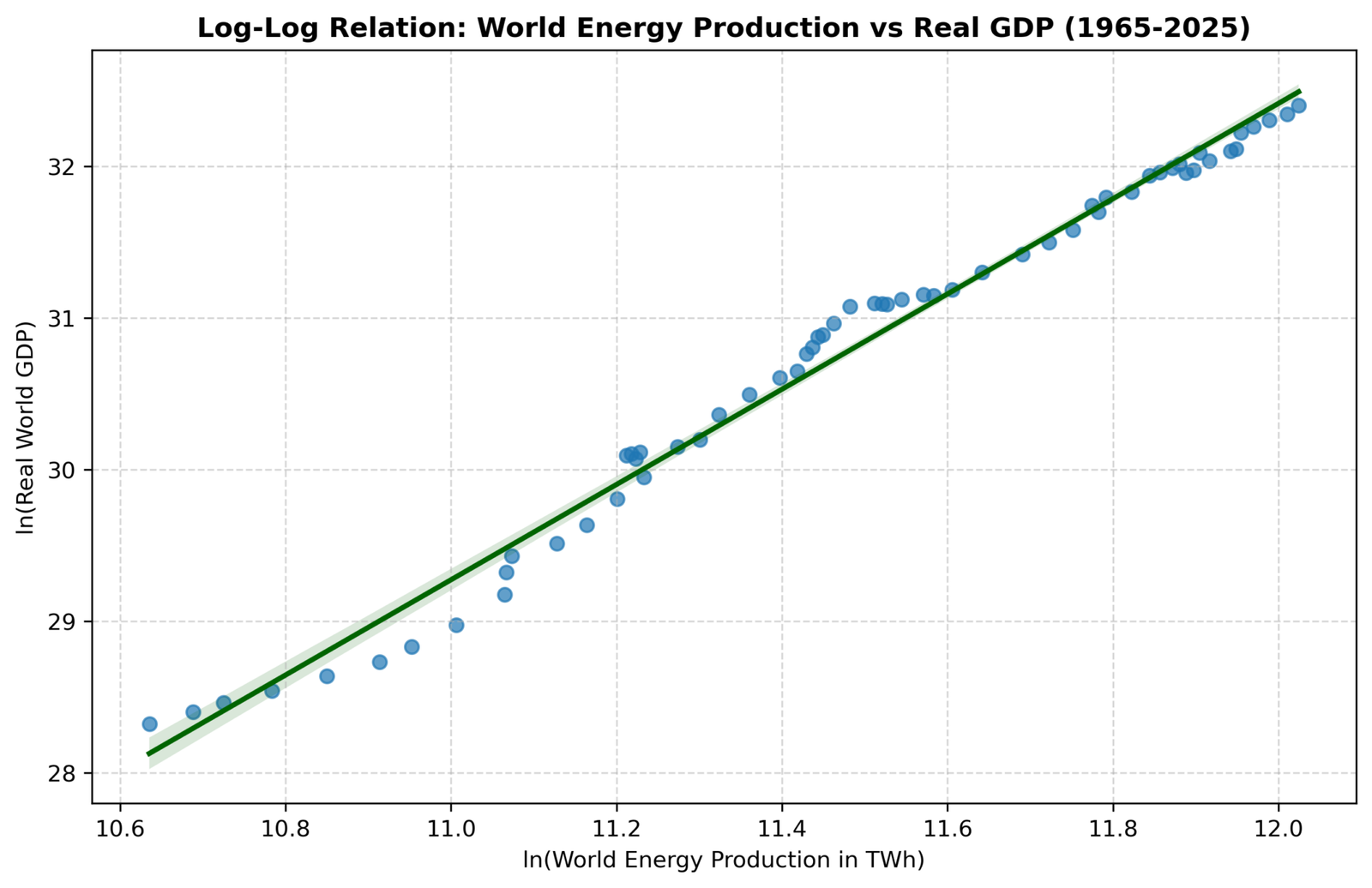
When I analyze the long-term relationship between global energy consumption (in terawatt-hour) and economic output (real GDP) from 1965 to 2025, I find a striking macro-historical link. Running an Ordinary Least Squares (OLS) regression in a log-log specification captures the profound structural scaling that has tethered industrialization to resource extraction over the past six decades. The regression yields an exceptionally high explanatory power, with an R2 of 0.987 and a log-energy coefficient of 3.14. Statistically, this means that over this historical window, a 1% expansion in global energy production has been systematically associated with a roughly 3.14% increase in global real output. While this coefficient largely reflects a shared long-term secular trend rather than a pure short-term multiplier, as highlighted by the low Durbin-Watson statistic of 0.168, it lays bare just how tightly bound modern economic growth has been to physical throughput.
This deep historical coupling raises a critical question for the future: what would happen if global energy production were to contract, whether driven by fossil fuel depletion, geopolitical bottlenecks, or the sheer friction of an energy transition?
Because the historical trajectory has been one of uninterrupted expansion, a downward shift in energy availability would test the symmetry of this relationship. Given an elasticity above 3, a contraction in primary energy supply would not merely clip growth at the margins; it risks triggering a severe, macroeconomic compression. Without radical improvements in energy efficiency or a complete decoupling of economic value from physical energy carriers, a decoupling that historical data shows has yet to occur at a macro scale, lower energy throughput would likely translate directly into contracting real GDP, posing profound challenges for financial stability, debt servicing, and global macroeconomic management.
Robert Pape escalation trap analysis
Geopolitical analyst Robert Pape highlights a broader, calculated strategy from Iran. He suggests their goal is to break America’s will to fight by « breaking » the Trump presidency ahead of the midterms, forcing Trump into an escalation trap.
Robert Pape defines the « escalation trap » as a strategic dynamic where short-term tactical military successes, such as precision air and naval strikes, fail to achieve long-term political objectives and instead create a cycle of retaliatory violence. He argues that this trap is particularly dangerous because each act of coercion by the United States often induces Iran to harden its stance or respond in ways that force the U.S. to choose between further escalation, potentially into a high-casualty ground conflict, or a humiliating concession. By focusing on tactical « wins » without a clear path to a political endgame, U.S. decision-makers inadvertently lose control over the conflict’s intensity, finding themselves locked into an increasingly volatile pattern that is difficult to reverse.
Regarding the upcoming U.S. midterms, Pape suggests that Iran is actively weaponizing this dynamic to exert maximum political pressure on the Trump administration. Iran is playing a long-term « coercive » strategy. By keeping the Strait of Hormuz shut, they aim to drive up gas prices, increase costs for the American consumer, and prove that Trump has no coherent strategy for victory, further weakening his political standing.
Robert Pape posits that Iran’s strategy is designed to expose the limitations of American power, particularly by leveraging its influence over strategic chokepoints like the Strait of Hormuz to threaten the global economy. By prolonging the conflict and testing American resolve, Tehran aims to force the administration into a corner: either accept Iran’s growing regional dominance or pursue a risky escalation that could become a liability ahead of the elections. For him, this creates a « strategic paralysis » where the U.S. is caught between a failed air campaign and the domestic political dangers of a broader war.
The timing is critical
As supplies (like oil and helium) run low and strategic reserves are tapped out, corporations and households will face a crisis of servicing their massive debts. If income dries up due to supply chain failures, bankruptcies are inevitable.
Steve Keen warns that when firms cannot produce goods, they cannot generate income to pay their debts. This creates a chain reaction: workers lose jobs, and banks are left holding bad loans, potentially leading to a financial sector collapse as equity goes negative.
Interestingly, the only thing currently keeping the U.S. economy afloat is that Trump has failed to successfully slash government spending as promised. High government deficits are currently providing a stimulus that keeps the economy ticking despite the self-inflicted damage.
We are witnessing a collision between aggressive geopolitical posturing and fragile economic fundamentals. If the war persists, the question may no longer be whether a recession will hit, but how deep it will be.